BME280 - Temperature, Humidity, Pressure Sensor
Overview
The BME280 is a digital environmental sensor that measures:
- Temperature
- Humidity
- Atmospheric pressure
In this course it is used to practice:
- I2C communication
- SPI communication
- Sensor configuration
- Reading calibrated digital sensor data
- Displaying measurements on display
Image
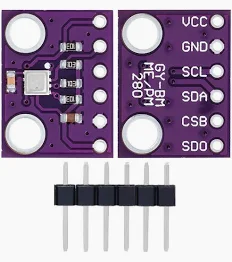
Key Specifications
- Supply voltage of sensor core: 1.7V - 3.6V
- Logic level: 3.3V
- Interface: I2C or SPI
- I2C address: 0x76 or 0x77
- Measurements:
- Temperature
- Relative humidity
- Atmospheric pressure
- Low power consumption
⚠ The bare BME280 sensor is not 5V tolerant. Some breakout boards include regulators or level shifting, but you must verify the module.
How It Works
The BME280 contains sensing elements and an internal ADC.
The sensor:
- Measures raw temperature, humidity, and pressure values
- Stores calibration constants internally
- Sends digital data to the MCU
- Requires compensation formulas, usually handled by a driver library
For most course projects, use an existing BME280 library instead of manually implementing the compensation formulas.
Basic Circuit / Connection
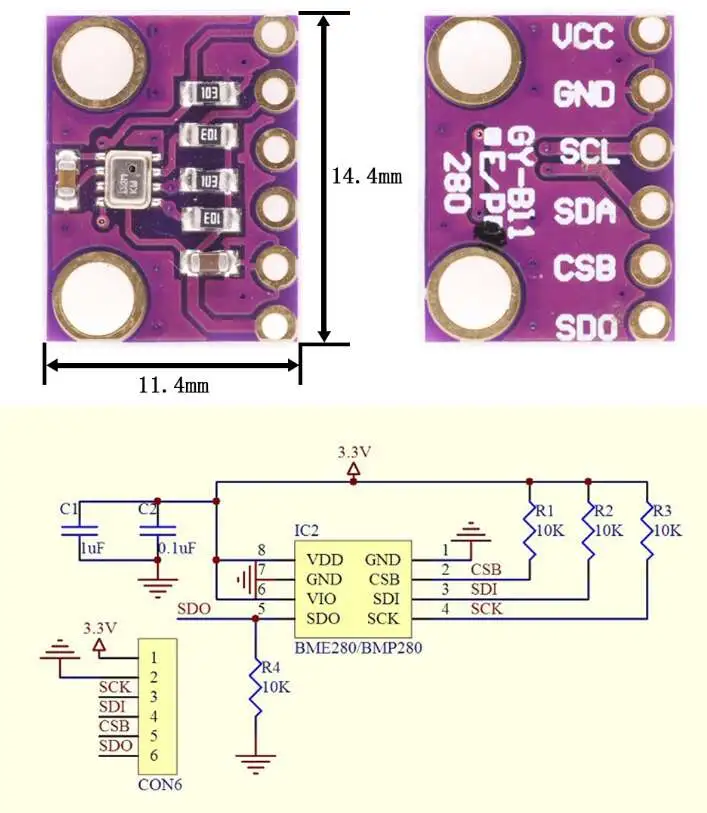
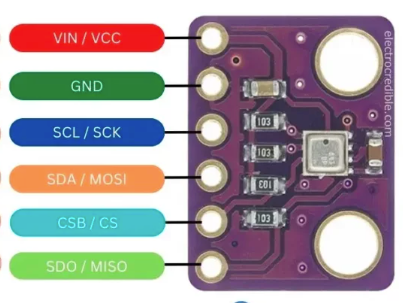
Typical I2C wiring:
| BME280 Pin | ESP32-S3 / STM32F411 Connection | Notes |
|---|---|---|
| VCC | 3.3V | Use 3.3V unless module clearly supports 5V |
| GND | GND | Common ground required |
| SDA | I2C SDA | Data line |
| SCL | I2C SCL | Clock line |
| CS | 3.3V | Selects I2C mode on many modules |
| SDO | GND or 3.3V | Selects I2C address |
Address selection:
- SDO -> GND: usually 0x76
- SDO -> 3.3V: usually 0x77
Important Electrical Notes
- Use 3.3V logic with ESP32-S3 and STM32F411.
- Do not connect sensor pins directly to 5V logic.
- I2C requires pull-up resistors on SDA and SCL.
- Many breakout boards already include pull-ups.
- Typical I2C pull-up values are 2.2k ohm - 10k ohm.
- Long wires can make I2C unreliable.
- Always use common ground.
Basic Calculations
I2C Pull-up Current
When an I2C line is pulled LOW, current flows through the pull-up resistor.
Example with 3.3V and 4.7k ohm:
This is safe for typical MCU and sensor I2C pins.
Pressure to Altitude (Approximate)
Pressure can be used to estimate altitude, but it depends on weather.
For beginner projects, treat this as an approximation, not a precise height measurement.
Typical Use in This Course
- Read temperature, humidity, and pressure over I2C
- Scan the I2C bus to find the address
- Display measurements on SSD1306 OLED
- Send sensor data over UART
- Log environmental values
Common Student Mistakes
- Using the wrong I2C address
- Swapping SDA and SCL
- Forgetting I2C pull-ups
- Powering a 3.3V-only module from 5V
- Not checking whether the module is BME280 or BMP280
- Expecting humidity data from a BMP280
Advantages
- Measures three environmental values
- Digital output is less noisy than raw analog sensors
- Low power consumption
- Widely supported by libraries
- Works well with 3.3V microcontrollers
Limitations
- Requires I2C or SPI driver code
- Not 5V tolerant as a bare sensor
- Humidity and pressure readings need calibration and settling time
- Altitude estimate depends on local pressure changes
Datasheet
Bosch official product page:
Bosch BME280 datasheet:
Summary
The BME280 is a useful digital sensor:
- Measures temperature, humidity, and pressure
- Uses I2C or SPI
- Usually runs at 3.3V logic
- Requires the correct address and pull-ups
- Is ideal for practicing sensor communication and data display