NTC Thermistor (10kΩ) – Temperature Sensor
Overview
An NTC thermistor (Negative Temperature Coefficient) is a resistor whose resistance decreases as temperature increases.
It is a simple and widely used analog temperature sensor.
In this course it is used to:
- Measure temperature using ADC
- Practice voltage dividers
- Work with analog signals
- Implement calibration and conversion to °C
Image
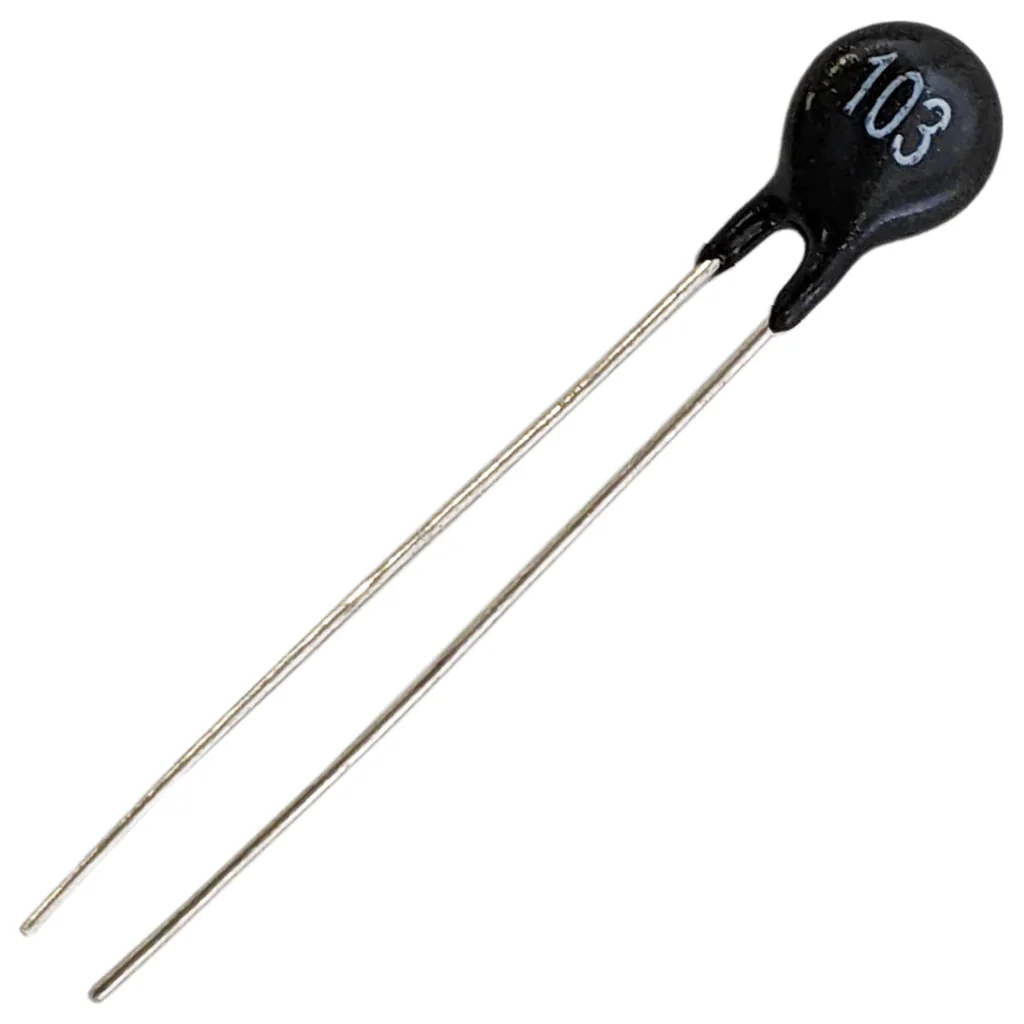
Key Specifications
- Type: NTC (Negative Temperature Coefficient)
- Nominal resistance: 10kΩ @ 25°C
- Behavior: Resistance DOWN when temperature UP
- Typical range: -40°C to +125°C
How It Works
- At low temperature → high resistance
- At high temperature → low resistance
Example (approximate values):
| Temperature | Resistance |
|---|---|
| 0°C | ~30kΩ |
| 25°C | 10kΩ |
| 50°C | ~3.5kΩ |
| 80°C | ~1kΩ |
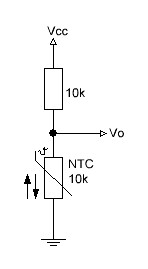
Basic Circuit (Voltage Divider)
NTC is used with a resistor to convert resistance change to voltage change (voltage divider):
Voltage Calculation
As temperature increases:
- \(R_{NTC}\) decreases
- \(V_{out}\) decreases
Converting ADC Voltage to Temperature
The NTC thermistor has a non-linear (exponential) relationship between temperature and resistance.
To get temperature from ADC readings, follow steps:
Step 1: ADC → Voltage
Step 2: Voltage → Resistance
From voltage divider:
Methods of Conversion to Temperature
1. Lookup Table (Recommended for Beginners)
- Precompute table: Resistance → Temperature
- Use interpolation between points
Example:
| Resistance | Temperature |
|---|---|
| 30kΩ | 0°C |
| 10kΩ | 25°C |
| 3.5kΩ | 50°C |
Pros:
- Simple
- Fast
- Easy to debug
Cons:
- Uses memory
- Limited precision unless table is dense
2. Beta (β) Equation (Good Balance)
Where:
- \(T\) = temperature (Kelvin)
- \(T_0\) = reference temperature (usually 298.15K = 25°C)
- \(R_0\) = resistance at \(T_0\) (10kΩ)
- \(B\) = Beta constant (typically ~3950)
- \(R\) = measured resistance
Convert to Celsius:
Pros:
- Good accuracy
- No lookup table needed
Cons:
- Requires
log()function - Slightly heavier computation
3. Steinhart–Hart Equation (Most Accurate)
Where:
- A, B, C = coefficients from datasheet
- T in Kelvin
Pros:
- Very high accuracy
- Works over wide temperature range
Cons:
- More complex
- Requires calibration data
Practical Recommendation for This Course
| Method | When to Use |
|---|---|
| Lookup Table | Beginners, fast implementation |
| Beta Equation | Default choice |
| Steinhart–Hart | Advanced students |
Common Mistakes
- Using °C instead of Kelvin in formulas
- Wrong Beta value
- Not matching R₀ and T₀
- Ignoring ADC reference voltage
- Not handling division by zero (V ≈ Vref)
Summary
Because NTC is exponential:
- You cannot use linear formulas
- You must convert: ADC → Voltage → Resistance → Temperature
Recommended approach:
- Start with lookup table
- Move to Beta equation for better accuracy
Why 10kΩ is Used in This Course
1. Matches MCU ADC Range
Using:
- NTC = 10kΩ @ 25°C
- Fixed resistor = 10kΩ
At room temperature:
→ Perfectly centered in ADC range → Maximum sensitivity around room temperature
2. Good Trade-off (Noise vs Power)
Compare with other values:
| Value | Pros | Cons |
|---|---|---|
| 1kΩ | Low noise | High current, wastes power |
| 10kΩ | Balanced | — |
| 100kΩ | Low power | High noise, unstable readings |
3. Works Well with Available Resistors
- 10kΩ resistors are standard in kits
- Easy voltage divider pairing
4. Safe Current Levels
At 3.3V:
→ Very low power consumption → Safe for continuous measurement
Power Dissipation
Example:
→ Extremely low → no heating effect
Important Notes
- NTC is not linear
- Requires conversion (table or formula)
- Often used with:
- Lookup tables
- Steinhart–Hart equation (advanced)
Typical Use in This Course
- Reading temperature via ADC
- Converting voltage → resistance → temperature
- Displaying temperature (OLED)
- Publishing data via MQTT
Common Student Mistakes
- Using wrong resistor value in divider
- Expecting linear behavior
- Forgetting ADC scaling
- Mixing up NTC and PTC
- Poor wiring → unstable readings
Advantages
- Very cheap
- Easy to use
- High sensitivity
Limitations
- Non-linear response
- Requires calibration
Summary
The 10kΩ NTC thermistor is ideal for learning:
- Analog measurement with ADC
- Voltage divider principles
- Sensor calibration
It provides the best balance between:
- Sensitivity
- Stability
- Power consumption