Servo Motor SG90 - Position Control Actuator
Overview
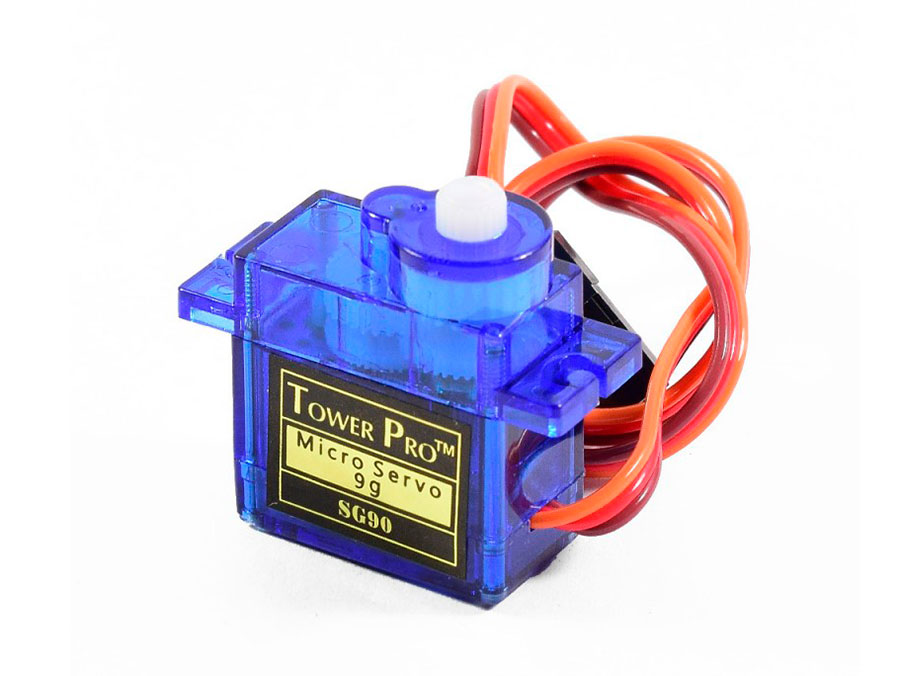
The SG90 servo motor is a small hobby servo used for simple position control.
Unlike a basic DC motor, a servo contains a motor, gearbox, position sensor, and control electronics inside one package.
In this course it is used to:
- Practice PWM-style control signals
- Move to a requested angle
- Build simple mechanical demos
- Understand separate power for actuators
Image
Key Specifications
- Type: Micro hobby servo
- Supply voltage: typically 4.8V - 6V
- Signal level: usually works with 3.3V GPIO
- Rotation range: usually 0 - 180 degrees
- Control signal: repeating pulse, about 50Hz
- Typical pulse width:
- 1.0ms -> one end
- 1.5ms -> center
- 2.0ms -> other end
⚠ The servo power pin should not be powered from a GPIO pin.
How It Works
The servo reads the width of the control pulse.
Every control period:
- A short pulse is sent on the signal wire
- The servo measures the pulse width
- Internal electronics drive the motor
- The output shaft moves toward the requested position
The signal is similar to PWM, but the important value is pulse width, not only duty cycle.
Basic Circuit / Connection
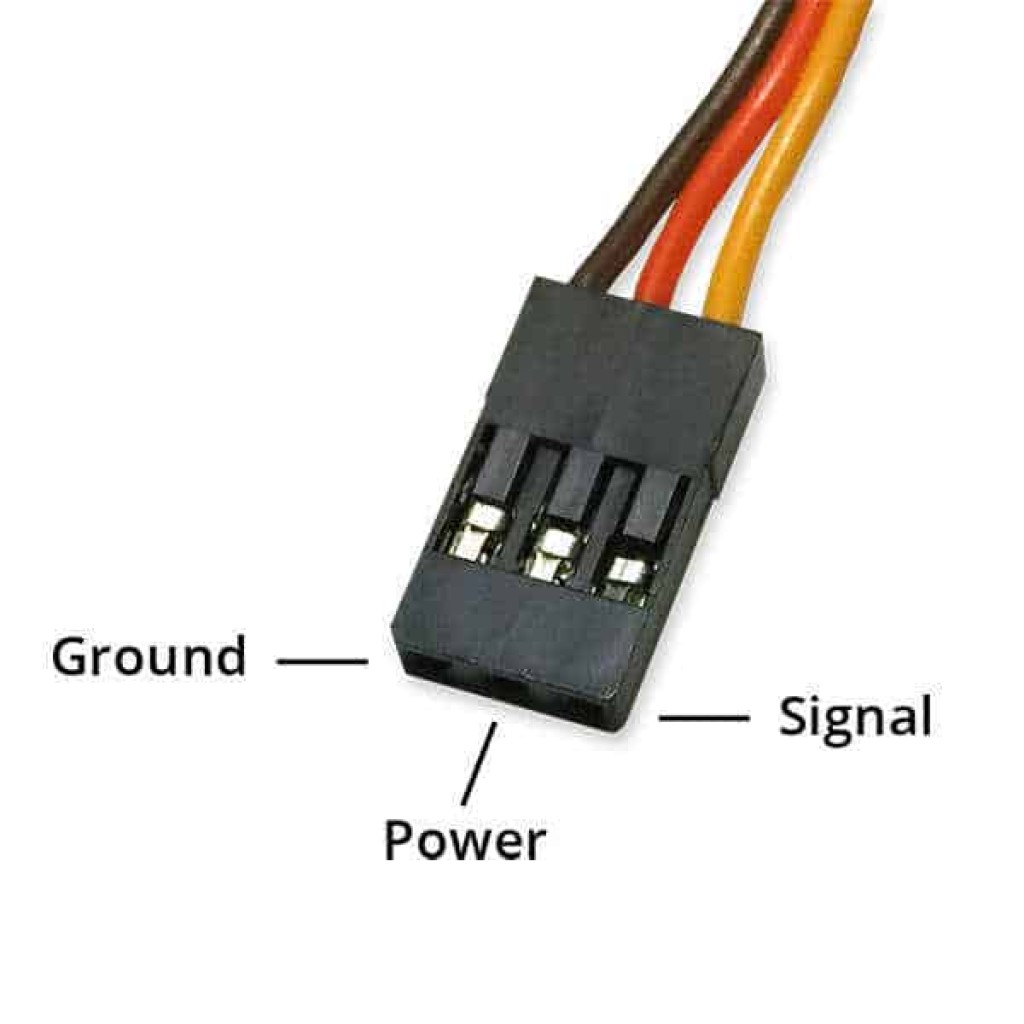
Typical SG90 wires:
| Wire Color | Function | Connection |
|---|---|---|
| Brown / Black | GND | External supply GND and MCU GND |
| Red | VCC | 5V servo supply |
| Orange / Yellow | Signal | GPIO PWM output |
⚠ Always share ground between the servo supply and the microcontroller.
Important Electrical Notes
- Do not power the servo from a GPIO pin.
- Do not rely on weak 3.3V regulator output for multiple servos.
- Servo startup and movement current can be much higher than idle current.
- Add a capacitor near the servo supply if the MCU resets during movement.
- Keep mechanical load small for SG90 servos.
- Avoid forcing the servo by hand while powered.
Basic Calculations
Pulse Period
Most hobby servos use about 50Hz:
\[
T = \frac{1}{f} = \frac{1}{50} = 20ms
\]
Duty Cycle Examples
\[
Duty = \frac{t_{pulse}}{T} \cdot 100\%
\]
For a 1.5ms center pulse:
\[
Duty = \frac{1.5ms}{20ms} \cdot 100\% = 7.5\%
\]
Typical values:
| Pulse Width | Approximate Position | Duty at 50Hz |
|---|---|---|
| 1.0ms | 0 degrees | 5% |
| 1.5ms | 90 degrees | 7.5% |
| 2.0ms | 180 degrees | 10% |
Typical Use in This Course
- Move servo to fixed angles
- Control servo angle using a potentiometer
- Generate timer-based PWM signals
- Learn actuator power separation
Common Student Mistakes
- Powering the servo from GPIO
- Forgetting common ground
- Using the wrong PWM frequency
- Confusing duty cycle with pulse width
- Using too much mechanical load
- Connecting the signal wire to an ADC-only pin
Advantages
- Easy position control
- Built-in gearbox and feedback
- Works well with simple timer output
- Good for mechanical demos
Limitations
- Limited rotation range
- Not very precise under load
- Can draw high current during movement
- Not intended for continuous rotation unless modified
- Mechanical gears can wear or break
Summary
The SG90 servo is a beginner-friendly position actuator:
- Uses pulse width to select angle
- Needs a proper external supply
- Usually accepts 3.3V control signals
- Is excellent for learning timers, PWM-style signals, and actuator wiring