Potentiometer (10kΩ / 20kΩ) – Adjustable Resistor
Overview
A potentiometer is a variable resistor that allows manual adjustment of voltage.
It is commonly used as a user input device.
In this course it is used to:
- Generate analog input for ADC
- Simulate sensor values
- Control parameters (brightness, speed, thresholds)
Image
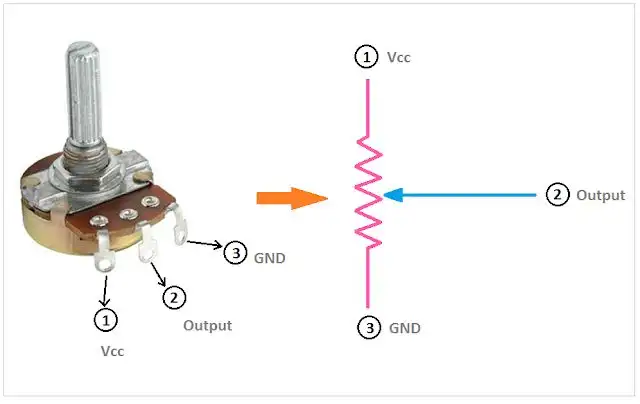
Key Specifications
- Type: Variable resistor (3 terminals)
- Typical values:
- 10kΩ
- 20kΩ
- Adjustment: Rotary (knob)
- Output: Analog voltage
How It Works
A potentiometer consists of:
- Two fixed terminals (ends of resistor)
- One wiper (middle pin)
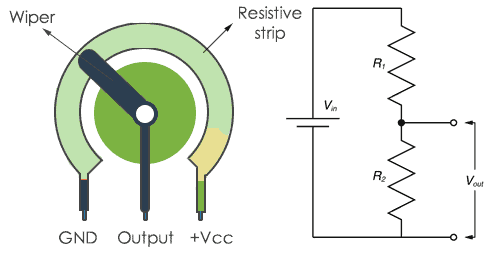
As the knob rotates:
- Wiper moves along resistive track
- Output voltage changes
Basic Circuit
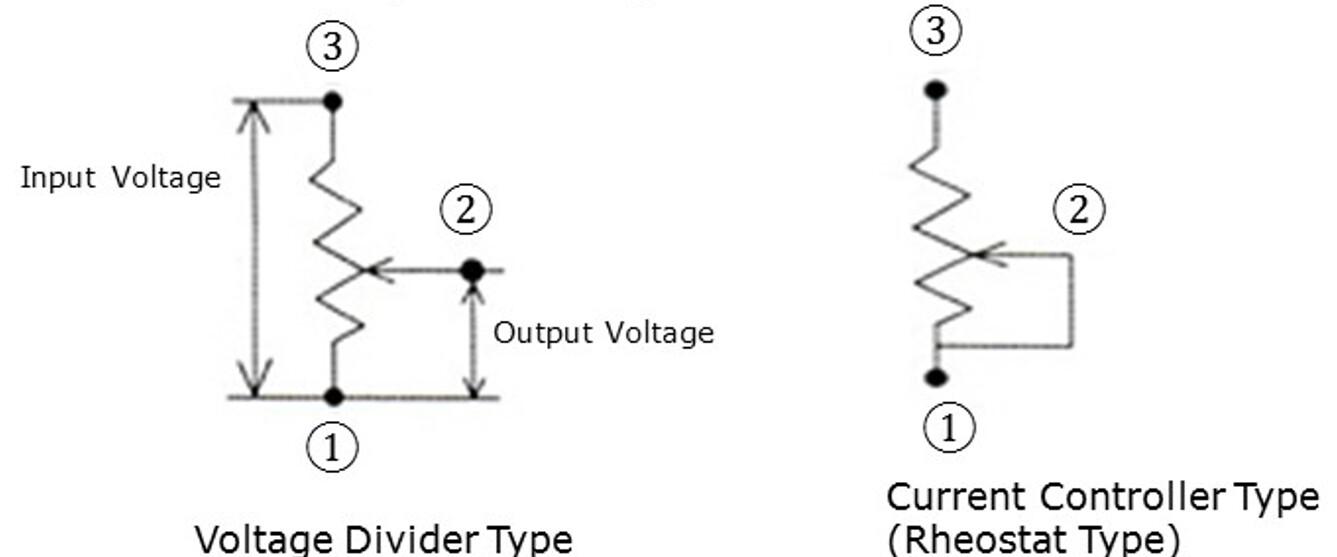
Connections:
- One side → VCC
- Other side → GND
- Middle pin (wiper) → ADC input
Voltage Output
\[
V_{out} = V_{cc} \cdot \frac{R_{wiper}}{R_{total}}
\]
- Fully left → ~0V
- Middle → ~Vcc / 2
- Fully right → ~Vcc
Why 10kΩ / 20kΩ Are Used
These values provide a good balance:
| Value | Pros | Cons |
|---|---|---|
| 1kΩ | Stable signal | High current consumption |
| 10kΩ | Best balance | — |
| 20kΩ | Lower current | Slightly more noise |
| 100kΩ | Very low power | Noisy ADC readings |
Current and Power
Example (10kΩ at 3.3V):
\[
I = \frac{3.3}{10k} = 0.33\ \text{mA}
\]
\[
P = \frac{3.3^2}{10k} \approx 1\ \text{mW}
\]
→ Safe and efficient
Important Notes
- Potentiometer acts as a voltage divider
- Output is linear with position
- No polarity (for resistive track)
⚠ Wiper must be connected to ADC, not the ends
Typical Use in This Course
- ADC reading practice
- User-controlled input (knob)
- Adjusting:
- LED brightness (PWM)
- Servo position
- Threshold values
Common Student Mistakes
- Connecting only 2 pins (wrong usage)
- Not using GND → unstable readings
- Expecting digital behavior
- Using too high resistance → noisy signal
- Miswiring wiper pin
Advantages
- Simple and intuitive
- Direct human interaction
- Stable analog signal
Limitations
- Mechanical wear over time
- Limited precision
- Requires ADC
Summary
The potentiometer is a basic input component:
- Converts position → voltage
- Works as adjustable voltage divider
- Ideal for learning ADC and user input