Resistors (0.5W) – Passive Component
Overview
A resistor is a passive electronic component that limits current and divides voltage in a circuit.
It is one of the most fundamental components in electronics and is used in almost every circuit.
In this course it is used to:
- Limit current (e.g., for LEDs)
- Create voltage dividers (for ADC)
- Pull-up / pull-down signals
- Set bias points in transistor circuits
Image
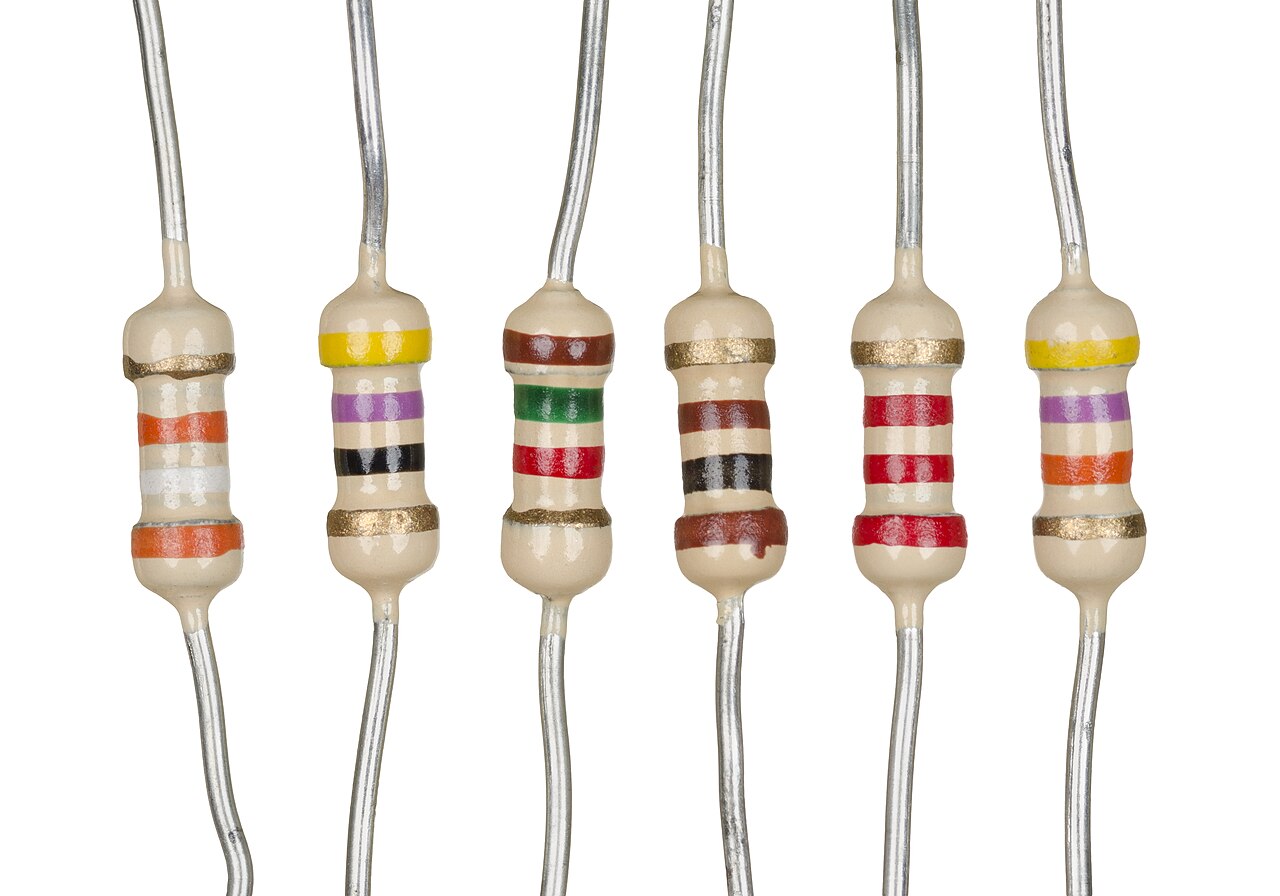
Key Specifications
- Type: Passive component
- Power rating: 0.5W
- Resistance values used in this course:
- 10Ω
- 100Ω
- 220Ω
- 1kΩ
- 10kΩ
- 100kΩ
- Tolerance: typically ±5%
Color Code (Example)
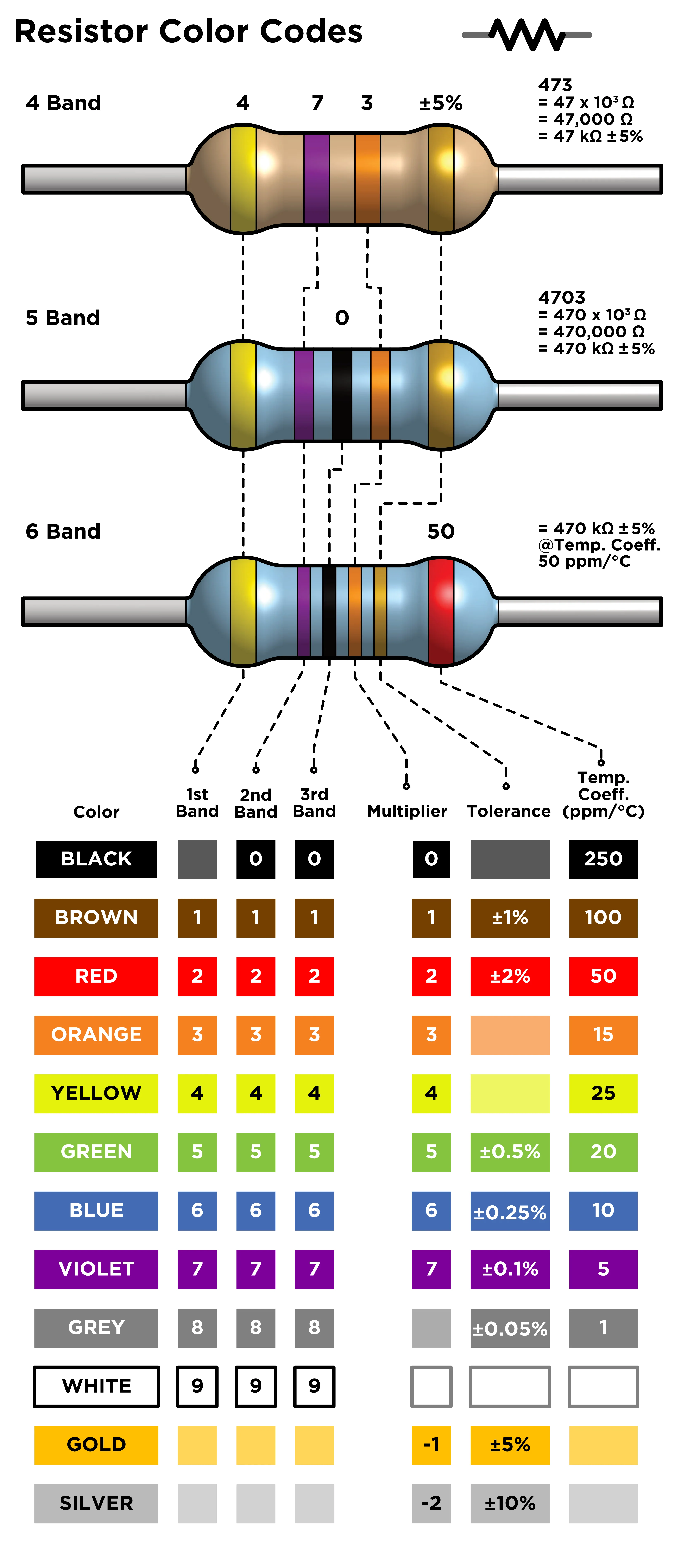
Resistors are marked with colored bands:
| Color | Value |
|---|---|
| Black | 0 |
| Brown | 1 |
| Red | 2 |
| Orange | 3 |
| Yellow | 4 |
| Green | 5 |
| Blue | 6 |
| Violet | 7 |
| Grey | 8 |
| White | 9 |
Example:
- Red–Red–Brown → 220Ω
SMD Resistors (Surface Mount)
SMD (Surface-Mount Device) resistors are widely used in modern electronics.
Instead of color bands, they use numeric codes printed on the body.
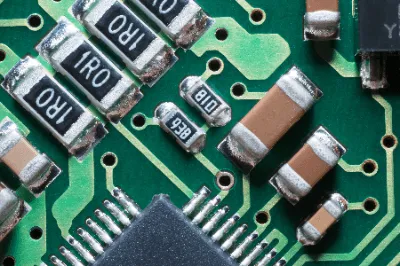
⚠ Chip resistors are black. Brown ones are chip capacitors.
Marking Codes
3-digit code (common)
Format:
- XY Z → (XY × 10^Z) Ω
Examples:
| Code | Value |
|---|---|
| 101 | 100Ω |
| 102 | 1kΩ |
| 103 | 10kΩ |
| 221 | 220Ω |
4-digit code (more precise)
Format:
- XYZ W → (XYZ × 10^W) Ω
Example:
| Code | Value |
|---|---|
| 1001 | 1kΩ |
| 2201 | 2.2kΩ |
Special cases
- 000 → 0Ω (jumper)
- Values < 10Ω may use:
- R as decimal point
- Example:
4R7→ 4.7Ω
Important Notes
- Same electrical behavior as through-hole resistors
- Much smaller size (0603, 0805, etc.)
- Power rating is lower (typically 0.1W – 0.25W)
Why This Matters in This Course
- Many modules (ESP32, sensors) use SMD resistors
- Helps understand schematics and PCB layouts
- Useful when debugging or identifying components on boards
Ohm’s Law
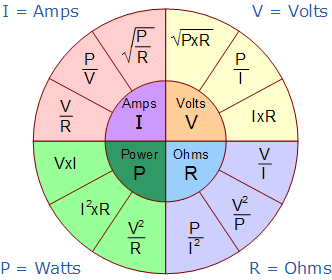
The most important relationship:
Where:
- V = voltage (Volts)
- I = current (Amps)
- R = resistance (Ohms)
Power Dissipation
Resistors convert electrical energy into heat.
⚠ Must stay below 0.5W rating.
Example Calculation
LED Current Limiting
Given:
- Supply: 3.3V
- LED drop: 2.0V
- Resistor: 220Ω
Safe for MCU and LED.
Voltage Divider
Two resistors can divide voltage:
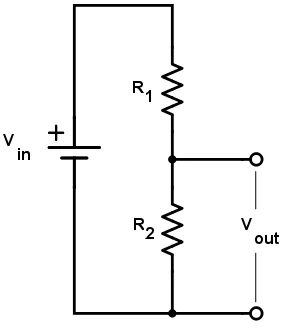
Example
- R1 = 10kΩ
- R2 = 10kΩ
- Vin = 3.3V
Typical Use of Values in This Course
| Value | Use Case |
|---|---|
| 10Ω | Current limiting (rare, high current) |
| 100Ω | LED (bright), signal protection |
| 220Ω | LED (standard safe value) |
| 1kΩ | General purpose, base resistor |
| 10kΩ | Pull-up / pull-down, voltage divider |
| 100kΩ | High impedance sensing |
E-Series (Preferred Resistor Values)
Resistors are manufactured using standardized value series called E-series.
These ensure evenly spaced values across decades.
More info:
Common E12 Series (±10%)
Used in basic electronics (often matches student kits):
| Decade | Values |
|---|---|
| ×1 | 10, 12, 15, 18, 22, 27, 33, 39, 47, 56, 68, 82 |
| ×10 | 100, 120, 150, 180, 220, 270, 330, 390, 470, 560, 680, 820 |
| ×100 | 1k, 1.2k, 1.5k, 1.8k, 2.2k, 2.7k, 3.3k, 3.9k, 4.7k, 5.6k, 6.8k, 8.2k |
Common E24 Series (±5%)
More precise, often used in this course:
| Decade | Values |
|---|---|
| ×1 | 10, 11, 12, 13, 15, 16, 18, 20, 22, 24, 27, 30, 33, 36, 39, 43, 47, 51, 56, 62, 68, 75, 82, 91 |
| ×10 | 100, 110, 120, 130, 150, 160, 180, 200, 220, 240, 270, 300, 330, 360, 390, 430, 470, 510, 560, 620, 680, 750, 820, 910 |
Why This Matters
Example:
Calculated resistor:
- 130Ω
Not available → choose nearest standard:
- 120Ω or 150Ω
Pull-up / Pull-down Resistors
Used to define default logic level:
- Pull-up → connects to VCC
- Pull-down → connects to GND
Typical value:
- 10kΩ
Series vs Parallel
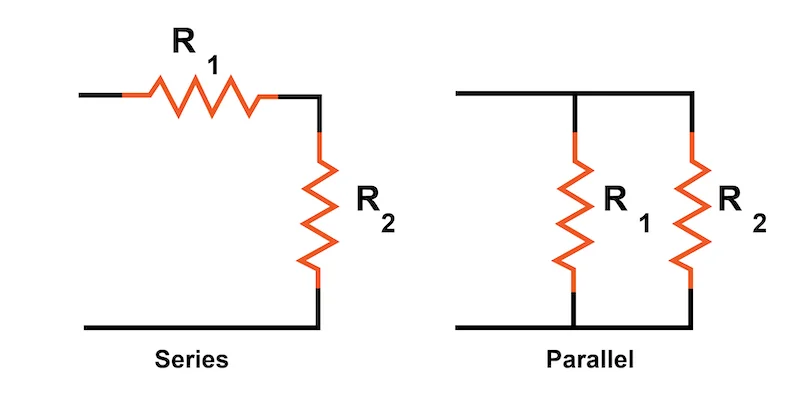
Series
Parallel
Important Notes
- Resistors are not polarized
- Can be connected in any direction
Common Student Mistakes
- Using wrong resistor value
- Ignoring power rating
- Mixing up kΩ and Ω
- Forgetting resistor for LED
- Incorrect voltage divider calculation
Typical Use in This Course
- LED current limiting
- Voltage dividers (LDR, NTC)
- Pull-up/pull-down for buttons
- Transistor base resistors
- Signal conditioning
Advantages
- Simple and reliable
- Essential for almost all circuits
Limitations
- Dissipates energy as heat
- Fixed value
Summary
Resistors are fundamental components:
- Control current and voltage
- Protect components
- Enable analog measurements
- Essential for nearly every circuit