Transistors (BJT: 2N2222, BC547B, BC557B) – Switching Component
Overview
A transistor is an active component used to control current.
In this course, BJTs (Bipolar Junction Transistors) are used mainly as:
- Electronic switches
- Signal amplifiers (basic understanding)
In this course it is used to:
- Control higher current loads (LEDs, motors)
- Interface MCU with external devices
- Learn switching and basic analog behavior
Image
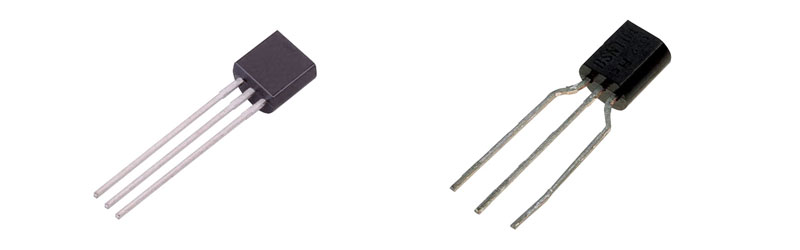
Key Specifications
NPN Transistors
- 2N2222
- BC547B
PNP Transistor
- BC557B
Typical parameters:
- Max current: ~100–600 mA (depends on model)
- Gain (β): ~100–300
- Base-emitter voltage: ~0.7V
Types
| Type | Behavior |
|---|---|
| NPN | Turns ON when base is HIGH |
| PNP | Turns ON when base is LOW |
Pinout (Typical)
- Base (B) – control input
- Collector (C) – current input/output
- Emitter (E) – reference (usually GND or VCC)
⚠ Pin order depends on transistor model
How It Works (NPN Example)
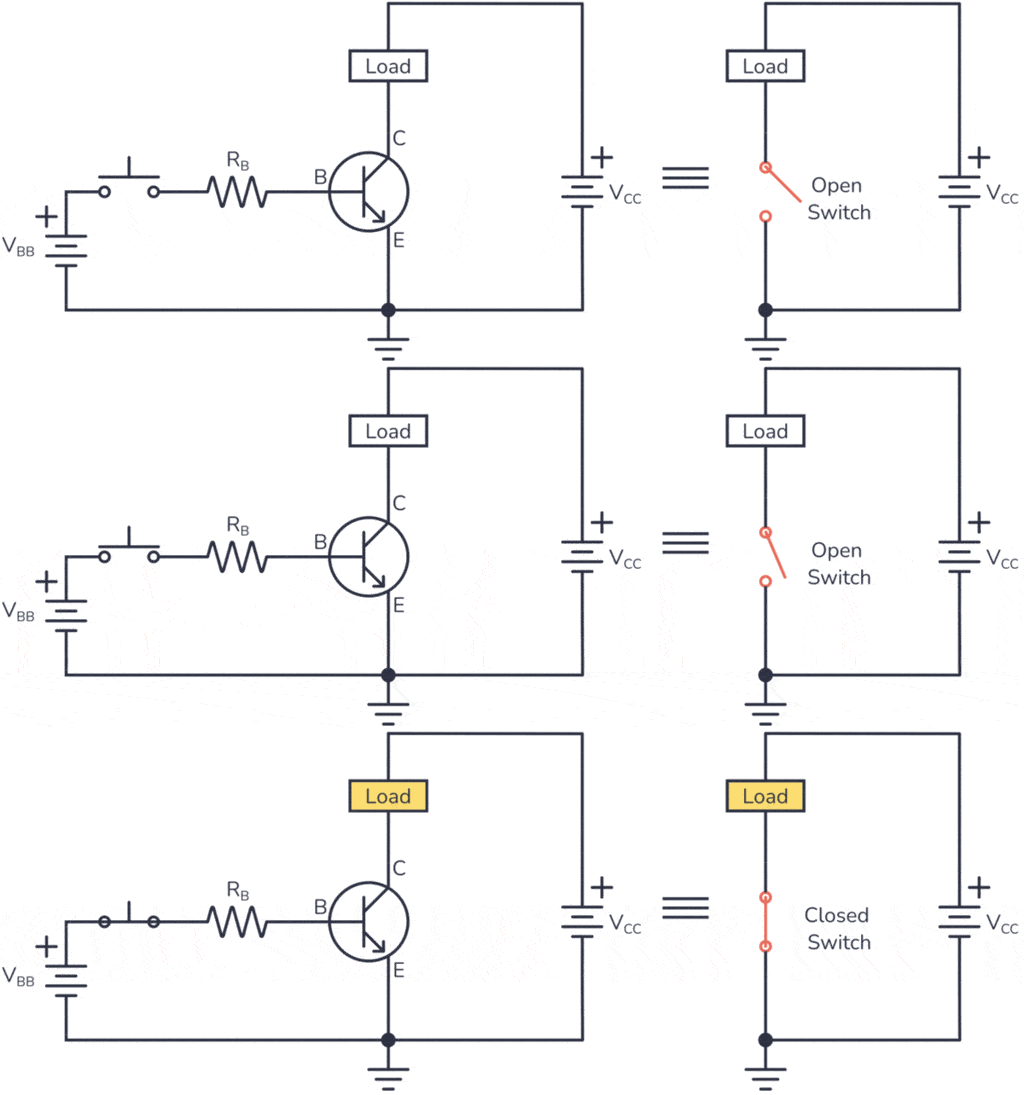
- Small current into base controls larger current from collector to emitter
\[
I_C = \beta \cdot I_B
\]
Basic Switching Circuit (NPN)
Base Resistor Calculation
To safely drive transistor from MCU:
\[
I_B = \frac{I_C}{\beta}
\]
\[
R_B = \frac{V_{GPIO} - 0.7}{I_B}
\]
Example
- Load current: 100 mA
- Gain (β): 100
\[
I_B = 1\ \text{mA}
\]
\[
R_B = \frac{3.3 - 0.7}{0.001} = 2.6kΩ
\]
→ Use 2.2kΩ or 3.3kΩ
Saturation Mode (Important)
When used as switch:
- Transistor should be fully ON (saturated)
- Ensure enough base current
Rule of thumb:
- Use forced β ≈ 10
Power Dissipation
\[
P = V_{CE} \cdot I_C
\]
In saturation:
- \(V_{CE} \approx 0.1–0.3V\)
→ Low power loss
PNP Usage (Brief)
- Works opposite of NPN
- Used for high-side switching
- Base pulled LOW to turn ON
Typical Use in This Course
- Driving LEDs with higher current
- Controlling motors (with diode protection)
- Interfacing MCU (3.3V) with higher loads
- Learning switching behavior
Common Student Mistakes
- No base resistor → MCU damage
- Wrong pinout → circuit does not work
- Not enough base current → transistor not fully ON
- Forgetting flyback diode (for motors)
- Mixing NPN and PNP logic
Advantages
- Simple and cheap
- Good for learning fundamentals
- Works well as switch
Limitations
- Requires base current
- Less efficient than MOSFET
- Voltage drop when ON
MOSFET (Short Overview)
A MOSFET is another type of transistor:
- Voltage-controlled (no base current)
- Higher efficiency
- Lower losses
Key Differences
| Feature | BJT | MOSFET |
|---|---|---|
| Control | Current | Voltage |
| Efficiency | Lower | Higher |
| Input load | Higher | Very low |
| Use case | Learning, simple switching | Power switching |
When to Use MOSFET
- Higher current loads
- Efficient switching
- Battery-powered systems
Summary
BJTs are essential switching components:
- Use small current to control larger current
- Require base resistor
- Ideal for learning transistor basics
MOSFETs are a more advanced alternative:
- More efficient
- Better for real-world power applications